
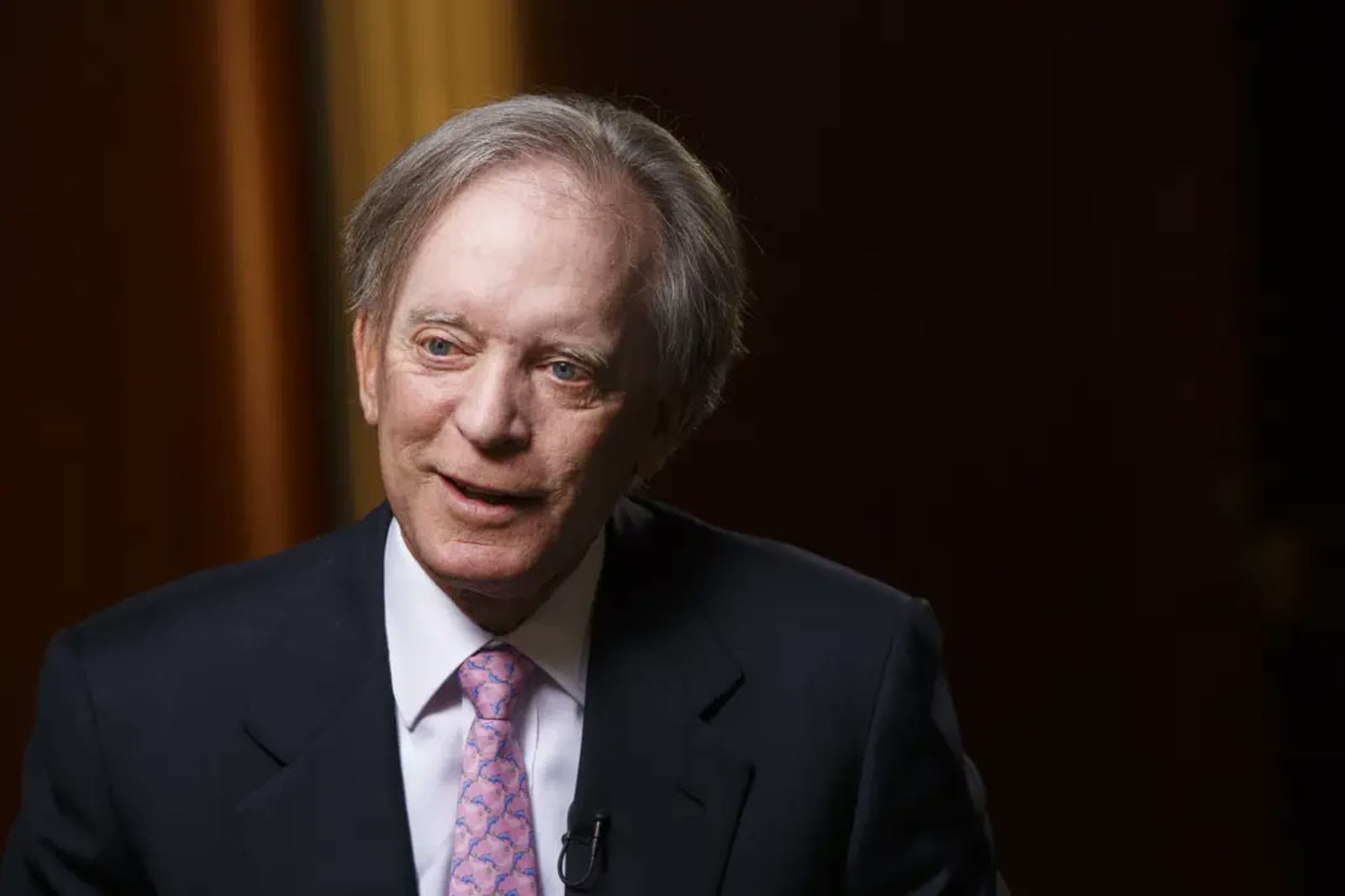
Bill Gross, the investor whose decades of bond-market dominance earned him the nickname "Bond King," is telling investors to steer clear of the asset class that made his career. In a Financial Times op-ed published Wednesday, Gross warned that global debt — government, mortgage, and corporate credit combined — has swelled to roughly $84 trillion, and that the balance between debt and equity has grown dangerously lopsided, according to Fortune's Jason Ma.
"Too much debt can lead to too much risk and too much equity can lead to less earnings per share growth under certain underperforming productivity cycles," Gross wrote, adding that growth tends to hold up when both expand at a pace consistent with the broader economy. That balance, he argued, has broken down: federal debt has reached peak levels for peacetime at 100% of GDP, and the debt-financed buildout of AI infrastructure marks a historical anomaly that is feeding near-term growth while storing up higher inflation and slower growth later.
"In such an environment, my view is: don't own bonds, with the exception of one-year Treasury bills, which are now at 4.55%," Gross wrote. He also cautioned against stocks at current valuations, arguing that rising yields will eventually compress corporate profit margins, and urged investors to brace for more volatility in benchmark 10-year Treasury yields than markets have grown accustomed to.
A market reshaped by new players
Gross's caution reflects a structural shift in who actually trades U.S. government debt. Central banks that once reliably bought and held Treasuries as reserve assets have increasingly diversified away from that role, while price-sensitive hedge funds have stepped in as far more active, and far quicker to sell, participants. A strategy known as the basis trade — in which funds profit from small pricing gaps between Treasury bonds and Treasury futures — has become especially popular, and hedge funds' share of total Treasury holdings has nearly doubled since 2023, to 8.5%, now exceeding the share held by depository institutions and mutual funds.
That shift has coincided with a volatile run for Treasury yields, which have climbed more than 100 basis points since the Iran war began and recently touched their highest levels in 24 years. Joe Maher, a markets economist at Capital Economics, warned in an August note that the growing hedge-fund presence could undercut bonds' traditional role as a safe haven during market stress. "In a risk-off environment, safe-haven flows into sovereign bonds may be offset by hedge funds unwinding their leveraged trading positions as funding conditions tighten," Maher wrote, noting that funds have no obligation to act as market makers, making it more likely that liquidity dries up precisely when it's needed most. He added that a selloff in one asset class, such as equities, could force funds to dump Treasury positions to cover losses elsewhere, transmitting stress across markets.
Where Gross sees safer ground
Gross said he remains skeptical of AI hyperscalers unless they trade at price-to-earnings ratios below 20, and flagged that telecom names like Verizon and AT&T, despite respectable dividend yields, face a longer-term threat to their core mobile businesses from SpaceX's Starlink. He pointed to some income funds trading at a discount to net asset value as a potential opportunity, while cautioning that they would suffer if short-term rates rise further than expected. "Preserve and protect is my current investment motto," he wrote.