
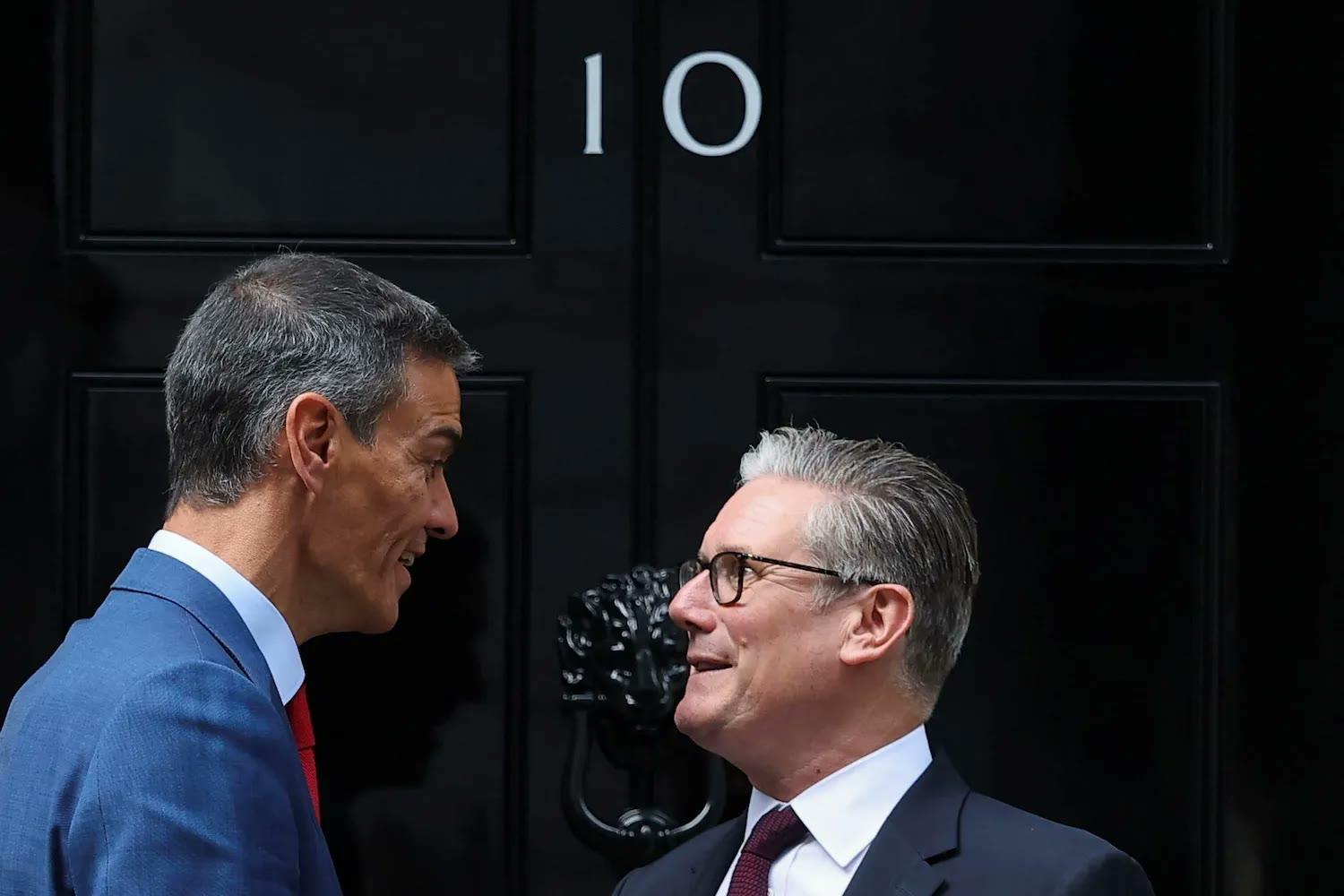
Last month, British Prime Minister Keir Starmer resigned after less than two years in office, replaced by Andy Burnham, the former mayor of Greater Manchester. It was a precipitous collapse for a leader who had won a 2024 landslide, and it stands in sharp contrast to his Spanish counterpart, Prime Minister Pedro Sánchez, who recently entered his eighth year in power and is gearing up for reelection, according to Bard College politics professor Omar G. Encarnación writing in Foreign Policy. Sánchez has survived the COVID-19 pandemic, the rise of the far-right Vox party, corruption scandals involving his own family, and an immigration crisis that saw roughly 70,000 people storm the Spanish enclave of Ceuta last month.
The contrast is sharper given the two leaders' starting positions, the analysis notes. Sánchez governs a fragile coalition in which his own Spanish Socialist Workers' Party does not even hold the most seats in Spain's parliament, a distinction that belongs to the conservative People's Party. Starmer, by comparison, entered office with 411 of 650 House of Commons seats, one of the largest working majorities in British history, and still could not hold on to it. Encarnación traces some of that gap to raw economic performance: Spain's economy grew almost 4 percent in 2024 and 2.9 percent in 2025, fueled by a post-pandemic tourism surge that led the Economist to rate it the world's top rich economy for 2024, while Britain's growth crept from 1 percent to a still-lackluster 1.3 percent over the same stretch.
But the piece argues structure and cohesion matter as much as economics. Spain has had just seven leaders since its 1978 democratic constitution, averaging six years each, while Britain has cycled through six prime ministers since the 2016 Brexit referendum, one of whom, Liz Truss, lasted only 49 days. Sánchez's coalition, anchored by his party and the multi-party Sumar alliance, is described as ideologically unified on immigration, European integration, and opposition to the U.S.-Israeli war on Iran. Labour, by contrast, is portrayed as unable to speak with one voice: immigration split the party as Starmer tried to head off pressure from the right, and the Iran war exposed further fractures after Starmer limited U.S. use of U.K. bases to "defensive" purposes, a far more cautious stance than Sánchez's outright refusal to let the U.S. use joint Spanish-American bases for the war.