
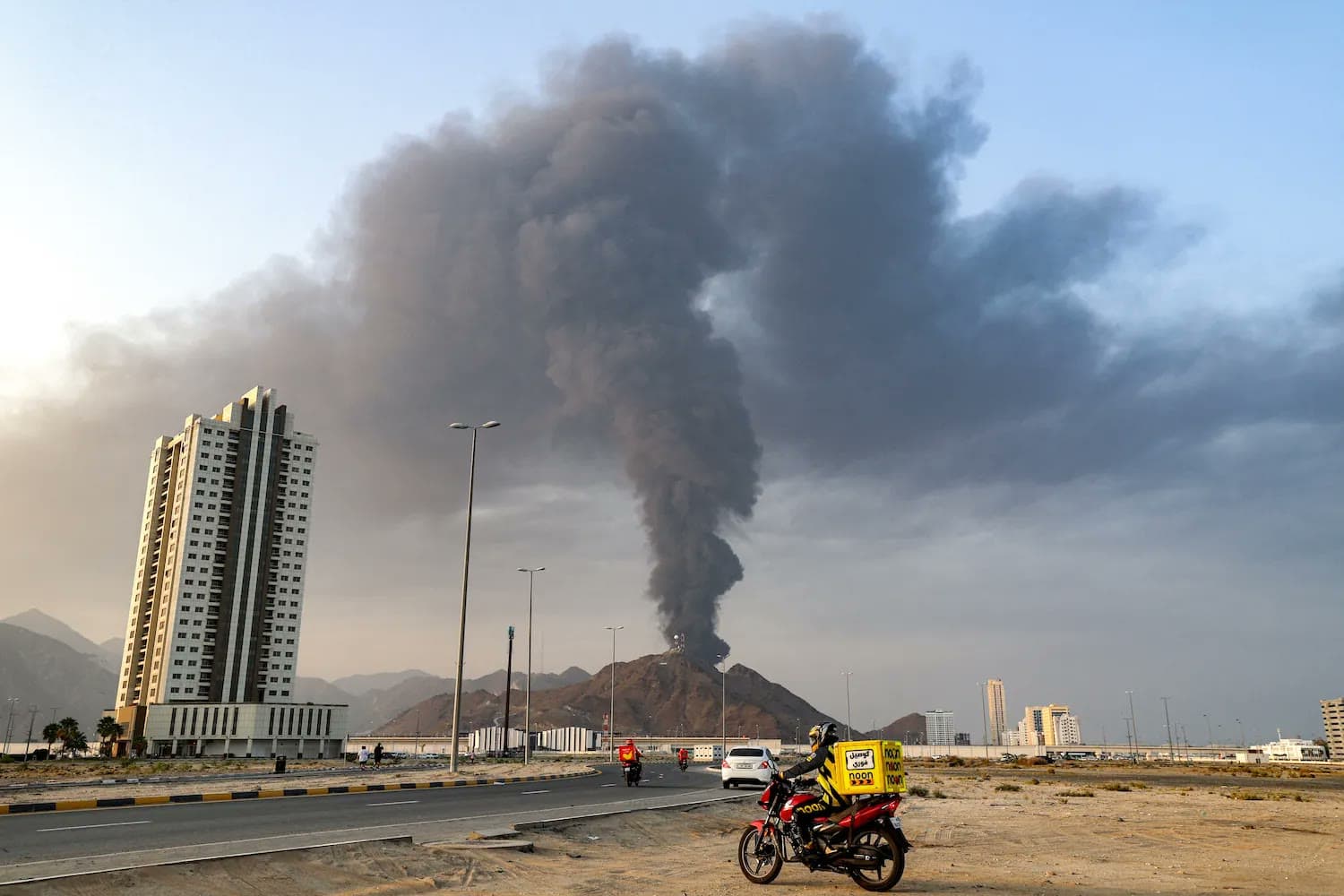
The United Arab Emirates halted all trade and financial transactions with Iran on Wednesday "until further notice," a sharp break after decades of close economic ties and a move that piles further pressure on Tehran to end its war ambitions, according to Foreign Policy's World Brief writer Alexandra Sharp. An Emirati Foreign Ministry spokesperson tied the embargo to "regional escalations that undermine regional and international peace and security," days after Abu Dhabi accused Tehran of attacking an Emirati oil tanker in the Strait of Hormuz and said Iranian forces fired two ballistic missiles at "maritime traffic," one of which landed in Emirati waters. Iran denied the missile attack.
The UAE has absorbed heavy fallout since the Iran war began, hosting both Al Dhafra Air Base, a major U.S. military installation, and the U.S. Navy's busiest port of call in the Middle East. Emirati authorities have logged more than 2,700 Iranian ballistic missile and drone attacks since the conflict started. Abu Dhabi had already taken smaller steps to punish Tehran, closing a Dubai cultural club, several schools, and a historic Iranian hospital linked to the Iranian government in March, canceling visas for some Iranian expatriates that same month, and, according to a New York Times report citing unnamed senior U.S. officials, quietly carrying out military strikes on Iranian territory in May. Until this week, though, it had stopped short of major economic penalties.
That restraint reflected how deep the economic relationship ran. The UAE was Iran's largest source of imports as of 2024, with bilateral trade around $28 billion that year, according to World Trade Organization data, and Dubai in particular has faced accusations of helping Tehran dodge international sanctions by hosting companies that processed money for the Islamic Revolutionary Guard Corps and other Iran-linked groups. Anwar Gargash, a diplomatic advisor to Emirati President Mohammed bin Zayed, dismissed those allegations on Wednesday as "untrue information and part of desperate media campaigns," while the Foreign Ministry said the UAE "remains firmly committed to safeguarding the integrity of the international financial system, in line with international law and the highest global standards."
Sharp notes it remains unclear why Abu Dhabi moved now, or how much U.S. pressure factored in; the Trump administration has repeatedly pushed allies to help isolate Iran, a strategy FP columnist Anchal Vohra has described as aimed at forcing "substantial concessions in negotiations, or even lead to an uprising that topples the regime." The embargo announcement came just hours after President Donald Trump held a call with Mohammed bin Zayed, a timing Sharp flags without confirming a direct link between the two events.