
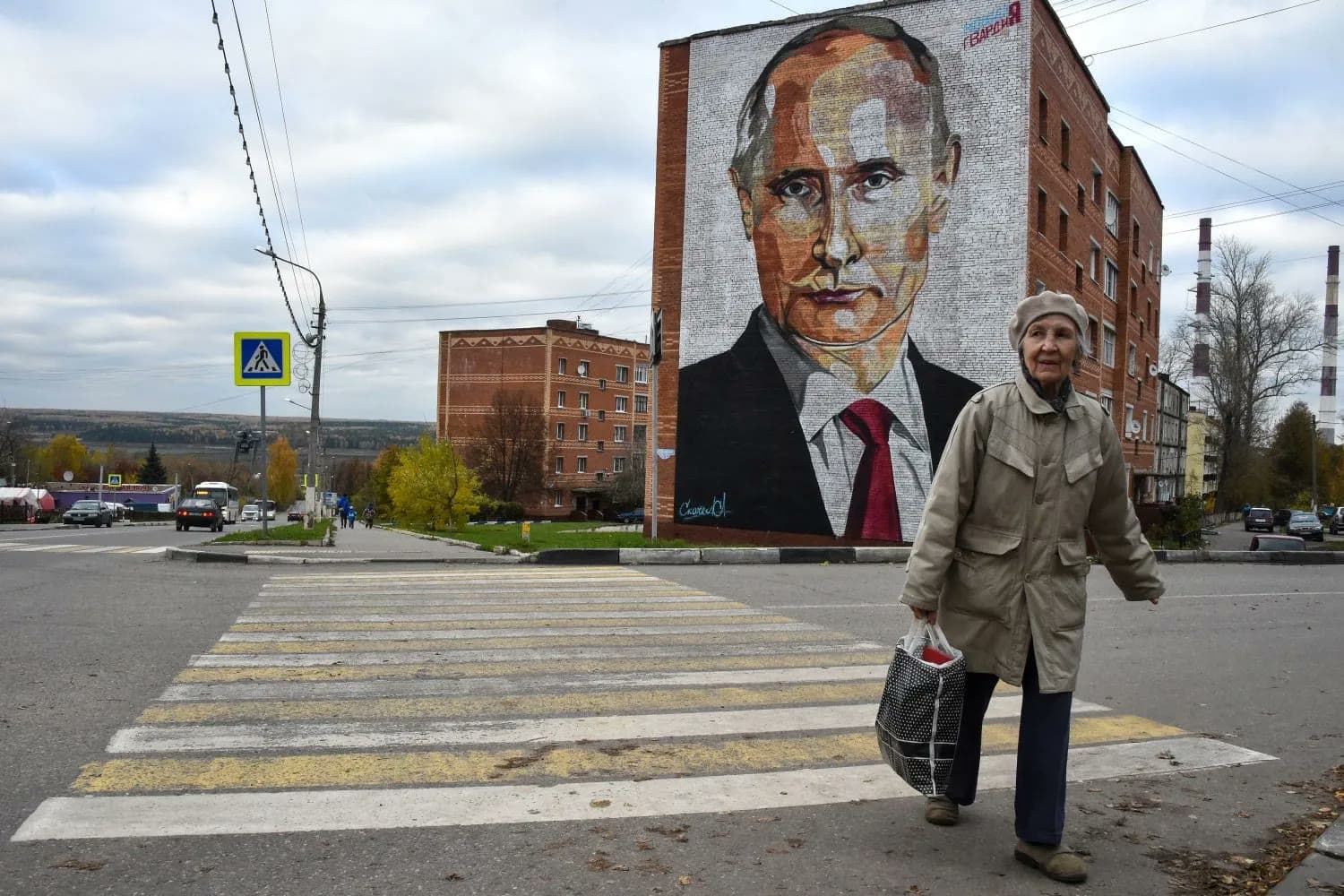
A Texan named Leo Hare moved his family to Russia in 2023, disillusioned with what he saw as American decadence and drawn by the promise of a society built on traditional Christian values. He was swindled out of $66,000 by a Russian contact he trusted, left his family homeless, and now says he has grown "increasingly concerned about the state of Russia's economy and restrictions on access to information." "I believed in the propaganda," he told an interviewer. Foreign Policy columnist Christian Caryl uses Hare's story to open a broader argument: that Western susceptibility to myths about Russian greatness is a centuries-old pattern, not a fringe phenomenon, and that it keeps recurring at the highest levels of media and policy alike.
Caryl's sharper target is The Economist, which recently ran a 7,000-word profile of sanctioned Russian billionaire Andrey Melnichenko alongside a 3,000-word essay by Melnichenko himself, framing him as a voice of reform. Caryl argues the essay said nothing Vladimir Putin himself could not have said: vague on internal change, expansive in demanding recognition of Russia's great-power status, and silent on the destruction and crimes committed in Russia's invasion of Ukraine. As Ukrainian readers pointed out, an oligarch of Melnichenko's stature almost certainly would not have published such a piece without tacit Kremlin approval, meaning the magazine likely did more for Russia's rehabilitation than the Kremlin's own allies on the American and European far right could have managed.
The column traces this susceptibility back to Voltaire, who praised Catherine the Great's brutal conquests as the imposition of Enlightenment values, and through a long line of prominent Western sympathizers: socialists like Sidney and Beatrice Webb who overlooked Soviet terror, playwright George Bernard Shaw praising Stalin's "impressive ability" three years into the show trials, New York Times correspondent Walter Duranty's notorious Moscow reporting, and U.S. Vice President Henry Wallace touring the Magadan concentration-camp network in 1944 without noticing anything amiss. Caryl argues part of the appeal is an implicit racial and religious bias: Russians "look European" and Russian Orthodoxy reads as recognizably Christian, prompting assumptions Westerners would never extend to authoritarian states in East Asia or the Middle East.
On the modern American right, Caryl points to Candace Owens praising the beauty of Russian churches while staying conspicuously silent when Russia bombed Kyiv's Pechersk Lavra monastery days after her visit, and to Tucker Carlson's widely mocked praise of a Moscow supermarket's shopping carts as evidence of civilizational strength. He notes Russia has one of the world's toughest gun-control regimes despite Republican assumptions about shared values, and that convicted Russian agent Maria Butina specifically cultivated that misconception. In 2024, U.S. prosecutors indicted two Russian agents for funneling money to conservative influencers who circulated pro-Putin narratives, evidence Caryl cites that these voices function as effective amplifiers rather than harmless cranks.
Caryl is careful to note the wishful thinking runs across the political spectrum: he cites the Obama administration's 2009 bet on Dmitry Medvedev as a reformist partner, a bet that collapsed once Medvedev proved to be a Putin placeholder who now ranks among Moscow's most hawkish voices on Ukraine. He also points to repeated overestimations of Russian military capacity by the U.S. policy establishment, including then-Joint Chiefs Chairman Gen. Mark Milley's 2022 warning that Kyiv could fall within 72 hours and political scientist John Mearsheimer's persistent predictions of Ukraine's imminent defeat. Caryl's conclusion is that these are all variations on the same myth of Russian immensity and strength, the same myth he argues has long convinced Donald Trump that Russia is the side to bet on, and credits Ukraine's resistance with showing the world it's time for that myth to die.