
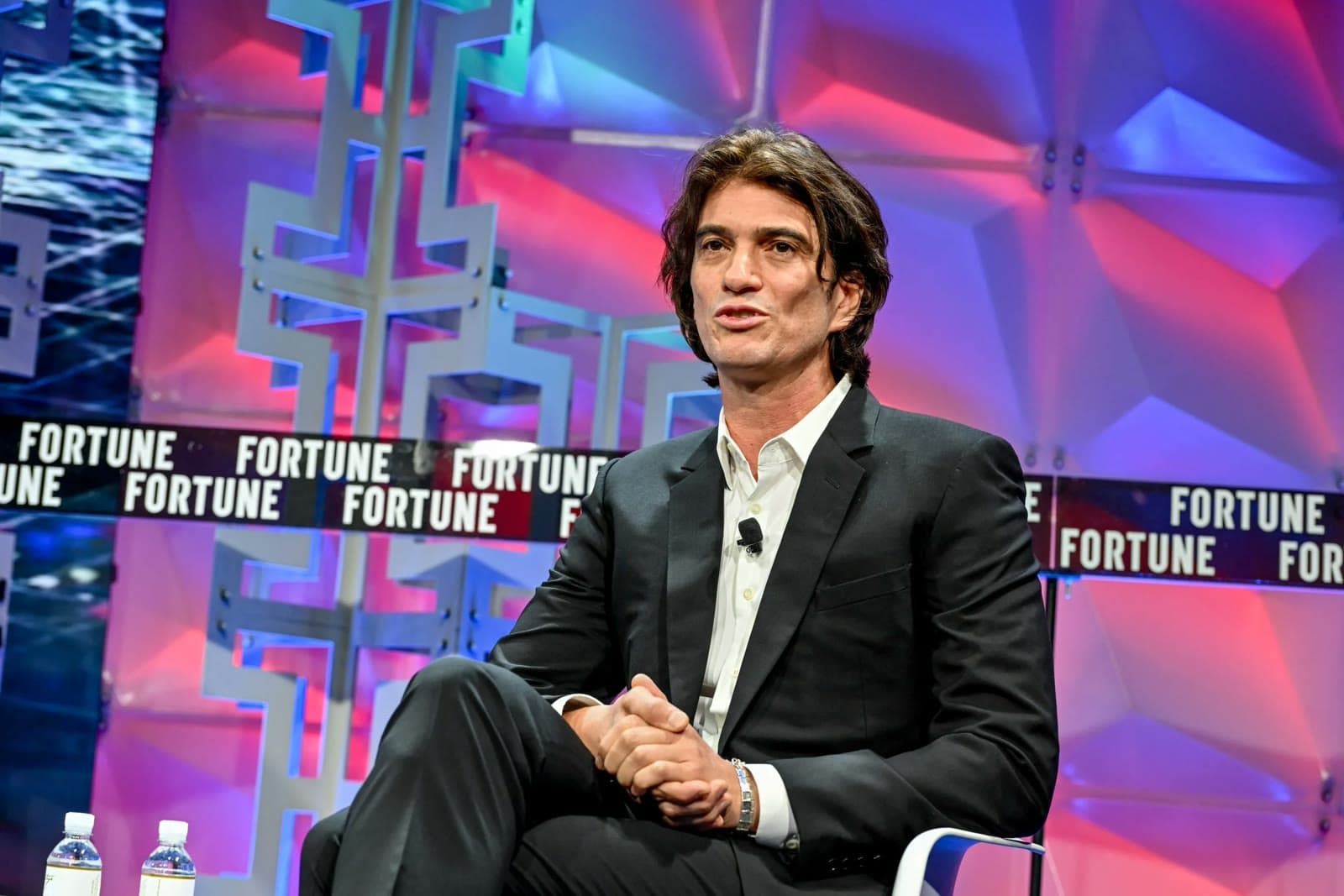
Adam Neumann says he can trace the unraveling of WeWork, the office-sharing company he built to a $47 billion valuation before its spectacular collapse, back to a single car ride with SoftBank founder Masayoshi Son in late 2016. Speaking on Steven Bartlett's "The Diary of a CEO" podcast in an episode released Sept. 28, Neumann described a WeWork board meeting the night before that had settled on a disciplined path forward: raise $300 million to $400 million, slow growth, turn a profit, and take the company public.
That plan lasted about as long as it took Son to walk into WeWork's lobby. Pressed for time ahead of a meeting with then-President-elect Donald Trump, Son spent only about 12 minutes there before inviting Neumann to continue the conversation in his car. By the time the roughly 30-minute ride ended, Son had offered close to $4 billion — "$4.2 to be exact," Neumann recalled — and the two had signed terms on a napkin before Son got out around 54th Street.
'By the time I walk into HQ, I forgot what we were all about'
Neumann walked the 36 blocks back to WeWork's headquarters alone, and says that walk marked a turning point. "The guy that sat in the car was a mission-driven entrepreneur who really believed in creating a world where people make a life and not just a living," he said. "Every step that I take, it goes higher and higher. And by the time I walk into HQ, 18th Street, I forgot what we were all about."
In the years that followed, WeWork's valuation and Neumann's personal fortune climbed in tandem with its losses. The company bought a roughly $60 million private jet Neumann used extensively, he and his wife Rebekah Neumann assembled a residential property portfolio the Wall Street Journal later valued near $90 million, and WeWork launched WeGrow, a for-profit school Rebekah led. Forbes pegged Neumann's net worth at $4.1 billion in March 2019, the same period WeWork disclosed a $1.9 billion net loss for the prior year.
From 13,000 employees to three in a week
The reckoning came that August, when WeWork's IPO prospectus — which described a mission to "elevate the world's consciousness" — drew investor scrutiny over its mounting losses and Neumann's concentrated control of the company. The offering was pulled, and Neumann stepped down as CEO weeks later. "I went from 13,000 employees to three employees in one week," he told Bartlett. WeWork's underlying business model, he acknowledged on the podcast, had never squared: "We were taking long-term commitments against short-term commitments," signing expensive long-term leases while renting space to members who could leave on short notice.
The pandemic-driven emptying of offices in 2020 compounded WeWork's problems, and the company filed for Chapter 11 bankruptcy in November 2023 carrying nearly $19 billion in debt. Neumann attempted a comeback bid in early 2024, reportedly lining up more than $500 million in financing to buy the company back, but WeWork exited bankruptcy later that year without him.
Redefining success, and a new venture
Neumann, now 47, told Bartlett he has reframed how he measures success — not by wealth, but by how he expects to feel looking back at the end of his life. "In that last moment, right before you go, how do you feel? Do you feel full and surrounded by love, and like life has been this amazing journey? Or is there regret?" he said, adding that "the one thing that happens right before we pass away: The ego goes away completely." He says he has no regrets about how WeWork ended. "I am so much happier today," he said.
Those lessons, he said, now inform Flow, the residential real estate startup he launched in 2022 with a $350 million investment from Andreessen Horowitz. "Falling is not bad," Neumann said. "The thing that's bad is not when you fall, it's how you get up. If you fell, you look around, you're like, 'Wow, everybody saw.' You clean up, you get up, and you say, 'Let's do it again.' If you have that in you, nothing will stop you."