
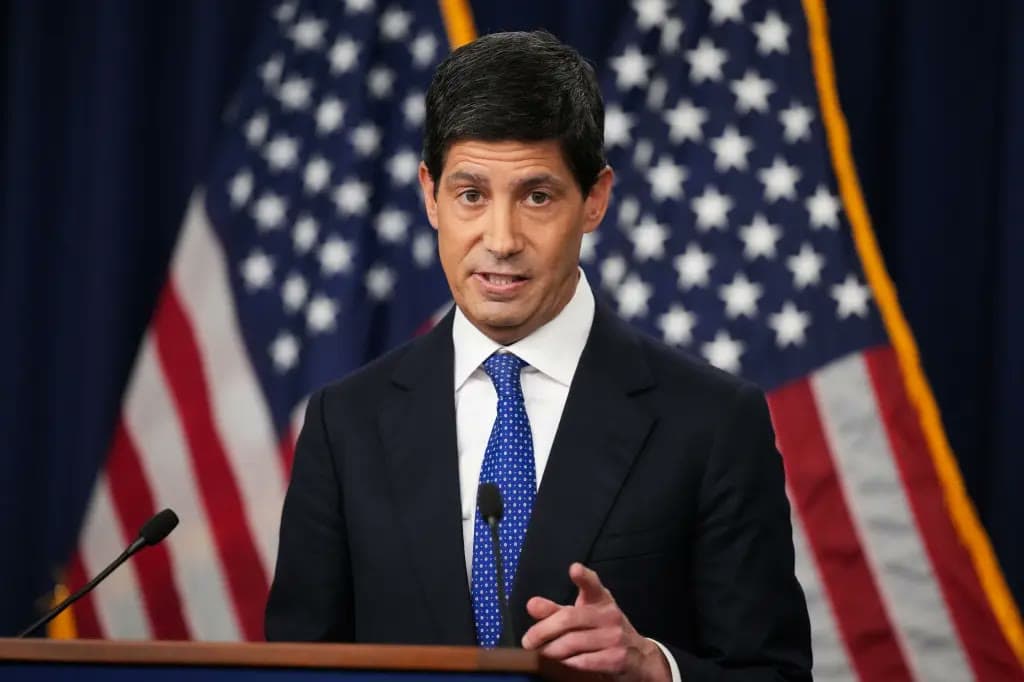
Federal Reserve Chair Kevin Warsh has quietly signaled a philosophical break from his predecessor that most coverage of his recent press conferences has missed, according to economist John Greenwood, writing in a Fortune commentary piece. Greenwood, a longtime monetarist, argues Warsh has effectively revealed himself as a fellow traveler of a doctrine that fell out of mainstream economic fashion decades ago, one holding that the money supply, not just interest rates, is the central driver of inflation and economic activity. That would mark a sharp departure from Jerome Powell's Fed, which Greenwood says consistently rejected monetarist thinking in favor of the Keynesian income-expenditure models that dominate the profession today.
Greenwood traces the shift to Warsh's remarks at the Fed's Jackson Hole Symposium in August, where he first floated the idea that changes in the money supply bear directly on inflation and output, and says Warsh expanded on it during his post-FOMC press conference on Sept. 16. In Greenwood's reading, Warsh made a distinctly monetarist argument that individual price movements, in energy or food for example, don't by themselves "cause" inflation; the Fed's job, as Warsh framed it, is to prevent those relative price shifts from cascading into broader, sustained changes in the overall price level, not to chase every individual price swing.
Greenwood points to several other moments from that same press conference as further evidence. Asked how a rate hike would affect lower-income Americans, Warsh said the Fed doesn't deal in questions of distribution, focusing instead on aggregates like the labor market, GDP, and overall inflation, while conceding that the lowest-income households, those without financial assets and living paycheck to paycheck, stand to benefit most from stable prices. Asked whether the latest CPI report influenced the decision to raise rates, Warsh dismissed the idea outright: "Datapoints are noisy," he said, arguing what matters is the underlying trend, which he judged still too high. And when pressed on where rates sit relative to the theoretical "neutral rate" economists call r-star, Warsh said the concept was of academic interest but carried no real bearing on the Fed's actual decisions.
Greenwood reads all three answers as consistent with monetarist orthodoxy: that short-term inflation forecasting is inherently unreliable given data noise, that distributional questions sit outside the Fed's proper aggregate-focused mandate, and that abstract concepts like the neutral rate are less useful than tracking the actual rate of money supply growth. On that last point, Greenwood argues broad money growth running in the 6 to 8 percent range over the past six to nine months has already been too high to hit the Fed's inflation target, a metric he says would have given Warsh a clearer read on financial conditions than debating where rates sit against an unobservable neutral benchmark.
Greenwood, who says he and a small group of fellow monetarists, including economist Tim Congdon, anticipated both the 2008 financial crisis and the post-COVID inflation surge that caught most mainstream forecasters off guard, frames Warsh's emerging framework as more than academic curiosity. If a Fed chair genuinely governs by tracking money supply growth rather than chasing monthly data points or debating unobservable rate benchmarks, Greenwood argues, it would represent what he calls a seismic shift in how the world's most consequential central bank makes policy, one he says Warsh is only now gaining the confidence to articulate clearly after a shakier start in his first two press conferences.