
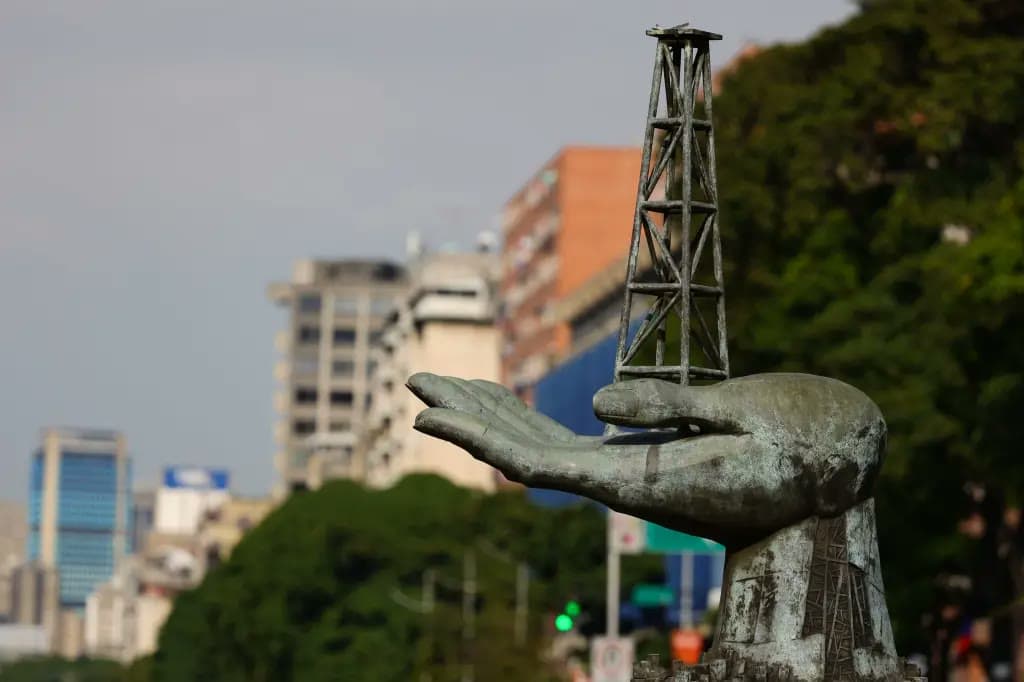
The United States, the world's largest oil producer, has never had a national oil company of its own, leaving crude production to private players like Exxon Mobil, Chevron, and the wildcatters scattered across the Permian Basin. That's changing through an unusual route: a deal giving Washington a majority stake in a new joint venture built around 65 billion barrels of Venezuelan oil reserves, according to Fortune's Jason Ma. Venezuela's interim president Delcy Rodriguez has granted a private company a 100-year lease on prime oil fields, a U.S. official said, with the federal government controlling 55 percent of the venture's effective output through equity ownership and production rights, and a private Venezuelan operator holding the rest. That stake alone would make the venture the world's second-largest corporate holder of proven oil reserves, behind only Saudi Aramco.
The scale involved is enormous even by the standards of a country that already holds the world's largest total oil reserves, an estimated 303 billion barrels. The 65 billion barrels covered by Trump's deal alone exceeds the entirety of proven U.S. reserves, put at 46 billion barrels. Rodriguez said the arrangement will bring in more than $100 billion of investment and generate $209 billion for Venezuela's government. The deal fits a broader pattern for the administration, which has already taken equity stakes in chipmaker Intel, rare earths miner MP Materials, and mineral explorer Trilogy Metals, alongside revenue-sharing agreements with Nvidia and AMD covering their chip sales to China.
The timeline behind the deal is striking. It lands roughly nine months after Trump ordered the U.S. military to capture Venezuelan leader Nicolás Maduro and bring him to the United States to face federal narcoterrorism and drug trafficking charges, and about eight months after the U.S. and Israel launched the war against Iran that triggered what Fortune describes as the worst energy supply shock in history, sending prices higher and forcing countries to draw down their own crude stockpiles. The U.S. Strategic Petroleum Reserve has since fallen to 289.7 million barrels, its lowest level since November 1982, with some industry experts warning it will soon approach operational minimums and lose whatever cushion remains against the Middle East supply deficit. A U.S. official told reporters the new Venezuelan venture's output is meant to help restock the SPR as production ramps up.